Being a creative marketing professional who actually gets to create is harder than you think, especially when it comes to moving your career forward. Not all of us want to be managers or executives, but we all want to thrive in our chosen field. Throughout this series, “Career Advancement Lessons from Star Trek: Lower Decks,” I want to help writers, designers, developers, and other practitioners learn how to speak up for themselves and their craft. Our goal? To do remarkable work worthy of respect and recognition in the workplace.
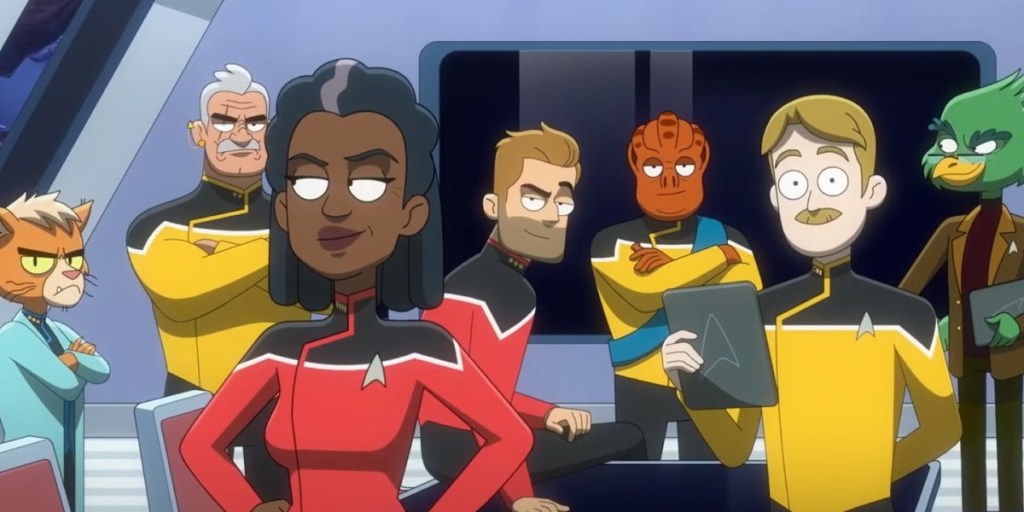
The Characters:
As a show, Lower Decks was focused on the lower-ranking officers. It’s right there in the title. We watched the main characters do the bulk of the day-to-day work while the senior officers sat in meetings and talked about big-picture ideas. Even worse, those senior officers often don’t explain their decisions with any sort of transparency or clarity. They simply give the crew members some basic instructions, told them to do the work without any oversight or guidance, and then critiqued them when they didn’t complete the task exactly like they would have.
Sounds like your average marketing department, doesn’t it?
But what the show also does is occasionally reveal the inner lives of those senior officers. Many of them actively miss doing the everyday work, despite how boring it can be. Yes, they like the power of making all the decisions all the time and the privileges of being in charge, but they don’t like being in meetings all the time. Like most over-achievers, they like being active and staying on top of what’s happening.
And for the most part, they’re good leaders:
- Captain Carol Freeman
- Commander Jack Ransom, First Officer
- Doctor T’Ana, Chief Medical Officer
- Lieutenant Shaxs, Security Chief
- Lieutenant Commander Andy Billups, Chief Engineer
- Doctor Migleemo, Counselor
In this installment, we’re going to view the junior officers through the eyes of their bosses. The goal is to shift perspectives just enough so that creatives and young professionals can better communicate with their bosses.
The Challenges:
The Cerritos is a California-class ship that spends most of its time on “second contact” missions. Their job is to provide diplomacy, support, and supplies to planets and civilizations that have just begun a relationship with the Federation. In many ways, such ships and crews as the junior officers of Starfleet. The “senior officers” on celebrated ships (like the more well-known Enterprise) get to have the initial chats and conversations with the new world, and then they zip off for other high-profile missions. Captain Freeman and her crew arrive later to tie up loose ends, check up on progress, and do all manner of problem-solving. They don’t get the attention or recognition they deserve for doing the hard day-to-day work of running an interplanetary organization.
Sounds like your average marketing leadership hierarchy, doesn’t it?
Topping it off, the senior staff has to wrangle the work, lives, and careers of the junior officers. Yes, they’re all talented – Starfleet only hires the best of the best – but some of them are needy suck-ups, while others are obnoxious malcontents. Still others are amazing workers who don’t realize they could be doing even bigger work, while still more need some motivation so that they don’t get stuck in their jobs. Thus, the big challenge for leadership rests in learning how to manage up and down the chain of command without getting burned by their own ambition. This proves especially difficult when it comes to developing clear and constructive lines of communication.
Many mid-level and mid-career managers across a wide spectrum of industries face these concerns on a regular basis. They have to address the concerns of senior leadership and shareholders as they continue for more growth. They also have to keep the team motivated to do good work that specifically achieves that growth while also keeping them fulfilled. Striking that tenuous balance between KPIs, quarterly decks, and inspired creativity can be much harder than many creatives imagine.
The Choices:
Because we’re examining the senior staff as a whole, let’s walk through a few storylines for our examples:
- Captain Freeman: Frustrated with what she perceives to be poor crew discipline, she implements a rigorous task system filled with check-ins, to-do lists, and timeframes. She told them what to do and how to do it based solely on her experiences and interpretation of the data. But instead of improving efficiencies by making everyone work to the exact same standard, the ship slowly falls into disrepair because she didn’t allow her crew to think for themselves. Once she realizes that she needs to let people make mistakes, take breaks, and learn for themselves does the ship finally begin to improve. (“Temporal Edict” – Season 1, Episode 3)
- Commander Ransom: Outside of Captain Freeman, he engages with Ensign Mariner the most. She is an extremely talented officer who rejects traditional leadership roles and mores as a matter of course. After some early season frustrations, he comes to realize that her unorthodox approaches do have a place and time, but he also helps her realize the value of operating within the larger structure of Starfleet. If she really wants to help people, why not figure out to do the most good with the most resources? {“I Have No Bones, Yet I Must Flee” – Season 4, Episode 2)
- Doctor T’Ana: The irascible chief medical officer is a trope throughout television history, and Lower Decks doubles down by having the good doctor be a Caitian – a literal cranky cat. When Ensign Tendi initially begins serving under her in Medical, T’Ana reacts dismissively to the junior officer’s brand of perky positivity. However, after working with Tendi and seeing how she’s unfazed by hard work and stressful situations, T’Ana becomes her mentor. She eventually recommends Tendi for the Senior Science Officer Trainee program, letting her know that it’s both OK to make mistakes and to speak with authority, especially when you know the right answer. (“Minding the Mind’s Mines” – Season 3, Episode 3)
The Chances:
The senior staff of the Cerritos believe in giving their crew multiple chances. Why else would Ensign Mariner still be on the ship? In fact, Ensign Boimler made his own fair share of mistakes in the beginning (though none as egregious or disrespectful as Mariner’s). That is often a sign of good leadership: They might not be the best teacher, but they do want you to learn, improve, and increase your skills.
One of my favorite episodes from the Season 1 of Lower Decks is “Veritas” (Episode 8). Through a hilarious series of misunderstandings, it appears that the senior staff is on trial, and the junior staff must account for their leaders’ actions to save them. However, they literally can’t – because they had never been told what was happening on a given mission. The crew members were present in the given scenarios, but they didn’t know what was going on, and they started complaining about it.
And we’ve all been there. We’ve had bosses and managers who keep things from us, whether for a single project or long-term strategy, and it makes us feel disconnected from the larger work of the company. However, as the senior officers stated, sometimes you can’t talk about every little nuance of every single project. But that means you have to cultivate trust on both sides of the situation, and that comes from a curious combination of communication and respect.
The senior staff of the Cerritos had to eventually trust themselves as leaders and doers to bring the ship together into a cohesive working unit. They had to become people worthy of being followed. The junior staff had to trust themselves as listeners and doers to advance their careers and make meaningful contributions to the ship. They had to become people worthy of being led.
Featured image courtesy of CBR.com.
 Dryvetyme Onlyne
Leave a comment