Introverted. In-depth. Incandescent.
Baseball has always been my favorite sport. I like the numbers, the order, the strategy. They make sense in my brain. They spark things in my brain. But I also love the whimsy: how the stadiums are all different sizes, the unbelievably arcane rules about the wackiest of scenarios, the unrivaled potential for chaos, and more. Sure, I could watch all of this play out on a television screen or phone screen – or, deity forbid, a gambling app – but the energy of attending a game in-person cannot be beat. The fusion of the statistical minutiae combined with the unknowability of how the events will play out makes me very happy.
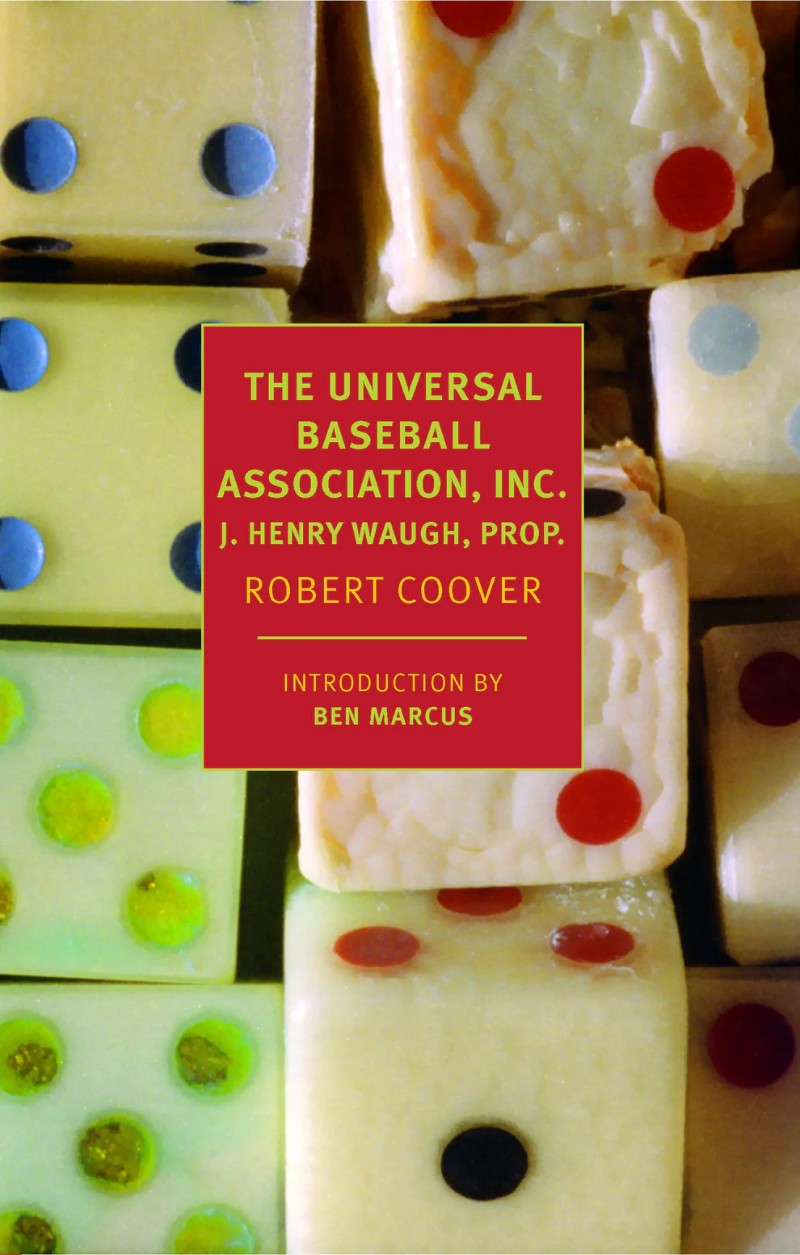
So, despite our mutual love of the arithmetical aspects of the game, J. Henry Waugh and I are at odds with how we truly enjoy baseball. Throughout The Universal Baseball Association, he openly talks about how he hates attending live events, preferring to play the dice-based baseball simulation game he created. By the time we begin reading the book, Waugh is fifty-plus seasons into the game, and he’s obsessed to the point that he is in danger of losing his job. He spends his days thoroughly engrossed in a self-created universe, including multiple lineages, competing political parties, and supremely detailed world-building. And when he manages to leave his tiny apartment for any social interaction, he often has to cosplay as one of the players to make sense of the situation.
In that sense, Robert Coover created an appealing installment of the midcentury incel with this 1968 novel. Bringing to mind an aging, less bitter Holden Caulfield, Waugh has a very active imagination, but it’s completely focused on a world that he controls to the nth degree. Any variation from his established order is a distraction that inhibits progress in the UBA, which means engaging with an everyday existence he doesn’t always understand. Baseball makes sense. It’s what matters. And yet, Waugh realizes that he should eventually give up the UBA, if not for his sanity in the present but in hopes of having any sort of stability in the future. That is until one improbable roll of the dice threatens to explode the game.
Republished in 2026 by New York Review of Books, the star of the novel is Coover’s concise wordplay. It’s pointed without being barbed, descriptive without being flowery. The baseball chicanery overflows with impeccable details that jump into the reader’s brain with a remarkable ease. Waugh’s creeping obsession never sits far from the surface, beckoning you into his brain to uncover what he tries to hide from polite society. But I also found him low-key relatable in terms of how devoted he is to the UBA, which makes me extra-glad I developed tools that help me balance my hobbies with the real world.
Come for the baseball. Stay for the deep psychological examination.
 Dryvetyme Onlyne
Leave a comment