Cerebral. Conflicted. Complicated.
There was a time in my life when I wanted to be a college professor. I wonder how many people who fall in love with a good liberal arts education share that same dream. You get to read a lot, write a lot, and talk to other smart people about smart things. You also get to share your intelligence, experience, and insights with generations of students who also like learning. Yes, you must deal with students who don’t revere your chosen field of study like you do, but the benefits of teaching the motivated students usually outweighs the downside of those merely taking your class to fulfill a prerequisite.
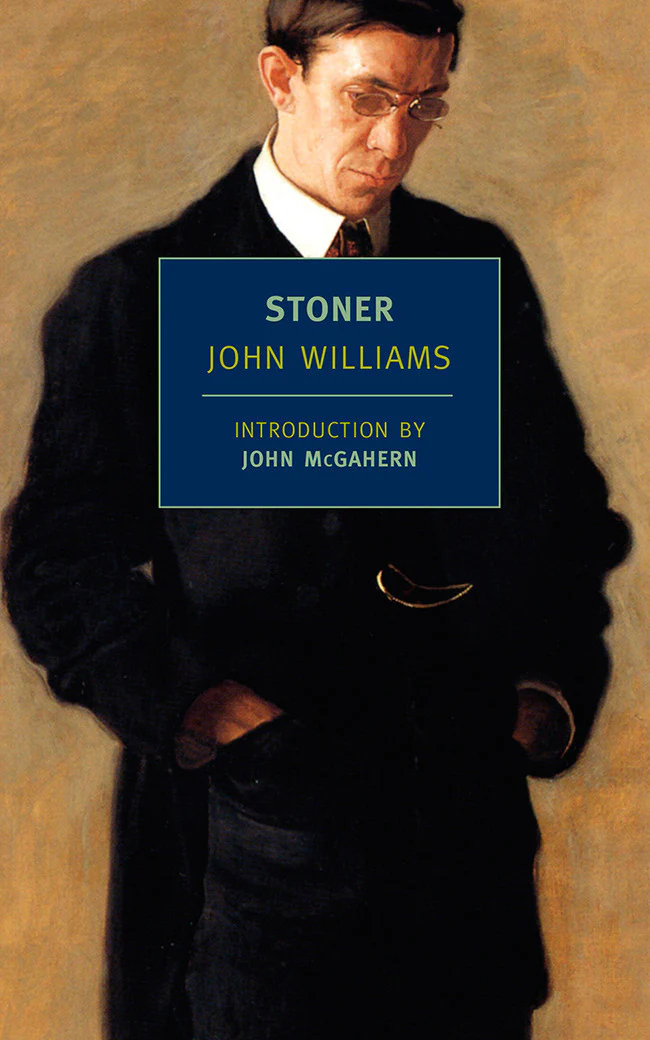
Thus, with the combination of my personal dreams of working higher education and the glowing reviews from people whose opinions I deeply respect rolling around in my head, I came to Stoner by John Williams with very high expectations. Published by New York Review of Books, this excellent tome met them – mostly. But something never really sat right with me, and it will stick in my craw for a while. Simply put, William Stoner, the titular character, is selfish, and the book never interrogates it.
To be clear, he isn’t the only selfish person in the story. His wife definitely is, and his chief rival in the English Department certainly is, but a rich lacquer of academic naivete coats Stoner, basically as a plot device. He is allowed to live with his head in the clouds, content with teaching, no matter what happens to him. Unhappy marriage? Oh well, he keeps teaching. His department chair hates him and gives him a terrible schedule? Oh well. He keeps teaching. His wife circumvents his parenting style and ostracizes him from his only child? Oh well. He keeps teaching.
This is not to say that he doesn’t have deep thoughts. He ruminates constantly. The book exists heavily in his head. He thinks often about his legacy as an educator and thinker. His one book was a non-entity in the field, except among fellow super specialists, and he often wonders what life might have been like had his best friend not died in World War I. His other best friend is his boss’s boss, the dean of the college, and he often protects Stoner from the more social and personality-driven aspects of the job.
The problem with the character and the book – which is masterfully written, despite my complaints – is that it feels stuck. After a sedate childhood working on the family farm, Stoner goes off to college and never leaves. He gets his undergraduate degree at the school, and because of a quirk of wartime need, he neither attends a different college for his doctorate nor goes to work at a different college for his first full-time job. Outside of a few minor vacations and trips to St. Louis, he spends his entire life in one mid-sized college town. It’s overwhelmingly provincial to the point that you can smell the chalkboard dust as you turn the pages.
But the prose. Oh, the prose. John Williams has created a fully lived-in and realized world for this story. Maybe the reason I can critique it so readily is because he has given me something worth deep, trenchant analysis. The sentences are often short and terse yet packed with life. The flow of events proceeds with ease, requiring the occasional time jump so that readers aren’t overwhelmed with the minutiae of daily life at a slightly above-average Missouri university. I devoured the book in four days because I needed to know exactly what was going to happen in the lives of these characters from the first half of the 20th century.
Cards on the table, I greatly preferred Butcher’s Crossing to Stoner, but I also want to re-read both novels by the end of this decade. Williams possessed a powerful penchant for creating rich and vibrant characters who make curious, often bad choices, yet you want to keep reading because the story is just that good. Thus, I don’t think I’m being unfair to this book when I say it didn’t live up to the hype, but I also readily accept that I probably misunderstood the hype and shouldn’t have started reading with such a lofty sense of anticipation. Should you read it? Absolutely – but maybe don’t watch a bunch of influencers talk about it first.
 Dryvetyme Onlyne
Leave a comment