Being a creative marketing professional who actually gets to create is harder than you think, especially when it comes to moving your career forward. Not all of us want to be managers or executives, but we all want to thrive in our chosen field. Throughout this series, “Career Development Lessons from Star Trek,” I want to help writers, designers, developers, and other practitioners learn how to speak up for themselves and their craft. Our goal? To do remarkable work worthy of respect and recognition in the workplace.
“Yet in all you say, where are the words duty, honor, loyalty, without which a warrior is nothing?” (“Heart of Glory” – The Next Generation, Season 1 Episode 19)
The Character
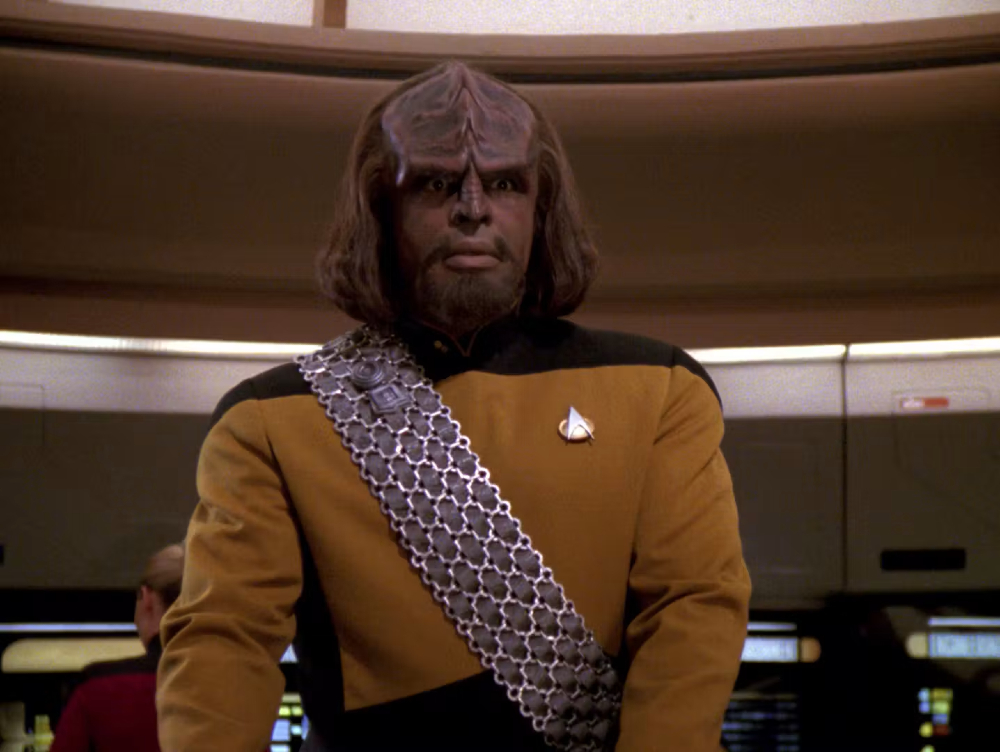
For Star Trek fans who revere the Next Generation, Deep Space Nine, and Voyager era, Worf is the ur text for diversity in the Star Trek universe. Sure, there are plenty of examples in those shows of what it looks like when people with different perspectives and backgrounds come together to solve problems. But few of them represent how he connects The Original Series in the 23rd century to those subsequent three shows in the 24th century like Worf. And the personal conflict and growth he experiences has many parallels to life in the 21st century for creatives working in marketing.
Worf is a Klingon male who was raised on Earth by humans after his parents were killed because of political machinations. But instead of returning to his home world when he became an adult, he instead chose to become the first of his kind in Starfleet. To Star Trek fans watching TNG in the ‘80s and ‘90s, this was a fascinating development, as Klingons had been the primary enemies of Starfleet in TOS. How was someone from such an aggressive race going to work amongst humans after so many decades of conflict? The answer, as born out over 7 seasons of TNG and 4 seasons of DS9, is to showcase how the character learns to accept himself, his imperfections, and the duality of his existence.
You see, Worf idealized Klingon culture – literally worshiping the mythology – but outside of the first few years of his life, he never interacted with it. Growing up with his human family on Earth, he absorbed everything he could, even though it was either the fantastical hagiography of Klingon folktales or the anti-Klingon propaganda of 23rd century Starfleet. So, when he eventually met real-life Klingons while serving on the Enterprise under Captain Jean-Luc Picard, he found himself battling significant internal conflict.
As the old saying goes, “Never meet your heroes.” Worf wanted to be like the strutting crew on the Klingon ships, but he quickly realized that the reality didn’t match the legends. These alleged warriors preached honor, but they often acted duplicitously, revering political strength over strength of character. And because he sticks to his principles, he served as the literal scapegoat for the entire Klingon Empire, as it refused to excise those who would harm the Empire because of tradition and socioeconomic expediency.
What does Worf have to tell us about contemporary marketing? Everything, if I’m being honest. As a creative, we frequently idolize the past. Just watching a single episode of Mad Men makes me want to run to New York City and work in a vintage ad agency as a copywriter. My designer friends wish they could develop sprawling magazine ads, funky commercials, punky websites, or simply anything with a soul. But when we look at the marketing landscape of today, it’s easy to get overwhelmed by SEO, AEO, GEO, AI, and management that wants it safe, quick, and cheap – and it has to “pop.” Like Worf, we feel conflicted between the dreams of the past, the reality of the present, and being pulled between creativity and corporatism.
The Challenge
I believe Worf could have had a relatively successful Starfleet career had he never faced the cognitive dissonance between the mythology of Klingon honor and how he experienced it in his interactions with actual Klingons. He was a strong and capable security officer with a growing capacity for tactical planning. However, that’s not the story the show presented us. Instead, we watched an increasingly nuanced character go to war with himself and his culture, often in very literal ways.
Worf’s challenge is that he had to decide not just what kind of Starfleet officer he wanted to be, but he had to figure out what sort of Klingon he wanted to be. As he quickly realized, the real-life examples in front of him left much to be desired: They were either duplicitous in how they acquired and retained power, or they were coarsely dismissive of how the elites wielded power because “that’s how it’s always been done.” While he rightly admired and respected Captain Picard, Commander Riker, and Captain Sisko as leaders in the workplace, he also recognized that he needed Klingon role models so that he could become a fully realized person in every part of his life.
Throughout all of TNG and Season 4 of DS9, Worf simply didn’t have anyone who deserved his respect. He played by all the rules, stuck to his principles, and acted honorably in every single encounter with both the Klingon High Council and individual soldiers. However, he found himself to be an outcast and his house disbanded because the Empire thought it more important to protect a wealthy house that engaged in treasonous activities because of its historical influence. He was a man without a people, and that caused him great consternation in his personal development.
Many creatives in marketing can resonate with Worf – not because they work with dishonorable people who share trade secrets with other companies, but because they find themselves doing work that isn’t actually creative. Even worse, they don’t work with anyone at their jobs who support them as creatives, much less encourage them to develop their skills. It’s one thing to have a boss who wants you to do better work, but it’s something entirely different to have a manager who trusts your abilities and provides tangible ways to improve them. You want to be challenged to do amazing work, but you are instead challenged by repetitive tasks that merely tick off checkboxes on a to-do list in hopes of hitting yet another deadline.
The Chance
Everything changed for Worf in Season 5 of DS9. He met General Martok when they were both captured and imprisoned by the Dominion, forced to engage in ritualized combat with Jem’Hadar soldiers. So much clicked for both men as they literally fought for their lives. For Martok, he finally got to meet the Starfleet officer who had rankled the High Council for so many years. He was a career soldier who came from the proletariat and succeeded, even though senior military leaders traditionally came from the landed gentry and bourgeoisie, using their wealth and connections to achieve their ranks. All he knew of Worf was what his superiors had told him, and it wasn’t very good.
For Worf, he got to see the Empire through the eyes of an experienced soldier who wasn’t part of the High Council and who wanted nothing to do with politics. It’s not that Martok was unaware of such machinations – serving in the military meant you were more familiar with the consequences of political action than civilians – but that he had no aspirations to ever serve as a political leader. Worf quickly realized that Martok wanted to be the best military leader possible, which to him meant serving the interests of the average rank-and-file soldier who would probably never rise in military rank, much less political leadership. Martok was the honorable Klingon leader that Worf has needed and wanted his entire life.
To be clear, Worf had great admiration for Picard, Riker, and Sisko – but they weren’t Klingons. They didn’t always understand his deep internal struggles about personhood, identity, and belonging. But Martok did. This was Worf’s chance to become the Klingon he’d always wanted to be. After securing their escape from the prison – along with Doctor Bashir and Garak – Martok offered Worf a place in his house. That meant protection for Worf’s embattled house and the opportunity to learn how to be an honorable Klingon with practical ethical application. It’s not that Worf wasn’t honorable, because he was to a fault, but more that Martok could show him how to apply those principles in ways that could affect actual change in the Empire.
Sometimes, a creative in marketing simply needs one good leader, one good manager, one good job to make the difference in your life and career. You can’t always predict where you will find this person, and they won’t always be immediately present. Sometimes, you must search for them in other parts of an organization. You might have a good enough manager now, but what if your actual mentor is on another team? Or an entirely different department? That could mean paying more attention in meetings where that person is present. Maybe it could mean asking to join them for lunch one day. It could even be as simple as asking for a 30-minute chat during a slow afternoon. And it doesn’t even mean that you need to look for roles on that person’s team. But it does mean that you need to know what you want from a job and then look for people who can help you secure that better future.
The Choice
Honestly, the choice was easy for Worf. He knew he had to spend as much time with Martok as possible. It helped that Martok liked him and wanted to see him step into his Klingon-ness as much as possible. It also helped that Captain Sisko knew Worf was the best possible candidate to build long-lasting ties between what he viewed as the ideal version of the Klingon Empire – one eventually led by Martok, instead of then-Chancellor Gowron.
Worf, after years of being misunderstood as both a Klingon in Starfleet and a Starfleet officer who was Klingon, had the opportunity to do more than balance his internal duality. Maintaining that dichotomy was no longer healthy for his life and career. They had to be merged into a unified whole so that he could honor his role in Starfleet and identity as a Klingon. He found a mentor who could support him and challenge him to be a Klingon warrior serving in Starfleet without needing to code-switch or mask.
In short, Worf could finally be himself at work, at home, with friends, or wherever he might be. This set him up for success because he didn’t need to hide who he was, depending on the crowd or audience. His outer confidence could match his inner strength because he found someone who modeled it for him and encouraged it in him. Worf and Martok weren’t identical in education, training, or upbringing – but they both recognized character and honor from a Klingon point of view.
I am on record as someone who believes that mentorship for creatives in marketing is virtually nonexistent. That’s the whole point of this series. But that doesn’t mean it’s impossible – it’s just difficult. You must put in the effort to find someone who gets you, who understands you. You might even have to market yourself a bit. Shocker, I know. If you’re anything like me, you believe that your good work will do the advertising for you. I’m here to tell you that such an approach rarely works. You must put yourself out there while also doing the good work.
That was Worf’s approach, whether he would describe it that way or not. He was a stellar officer but a confused Klingon, which often made him a conflicted person. But when it mattered, he acted honorably and did what was right, which caught the attention of Martok, the man who became his mentor. Thus, your career development might be hindered, not because you aren’t open to new possibilities, but because you aren’t open to the right people who can help you find those new possibilities. And if you’re lucky, those people will also help you become your best self.
Header image courtesy of StarTrek.com.


Leave a Reply