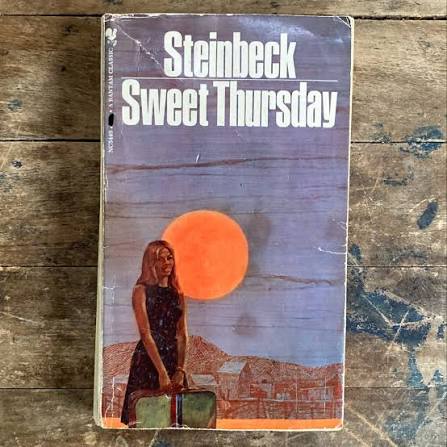
Scenic. Slow. Sentimental.
John Steinbeck was the first “classic” author I really loved. His stories always felt so lived-in and believable, as if the events I was reading about were happening just outside my bedroom door. I devoured delectable novellas like Of Mice and Men, The Pearl, or The Red Pony before ever attempting the “important novels” like East of Eden or The Grapes of Wrath. Sure, some of the midcentury phrasing felt odd at times, but I also came away from his books with a keen vocabulary and a penchant for authors who used place and time to increase the drama that the characters experienced.
However, I’d never even heard of Sweet Tuesday when I found it in a used bookstore a couple of years ago. I just assumed it was one of his minor works like The Moon is Down or The Wayward Bus – a book that only real Steinbeck nerds ever read. Instead, what I found was the sequel to Cannery Row, his tale about a bunch of down-and-out ne’er-do-wells living in the titular town after the factories closed. What follows reads like an interlocking series of extended riffs about people ekeing out a meager existence in the middle-of-nowhere central California.
The core stories swirl around Doc and Suzy. The former is a “Dude”-like figure who drinks just as much as he engages in scientific exploration of coastal marine life. The latter is a mysterious woman who enters the town looking for a job and a fresh start without ever revealing what brought her there. She wants to escape her past, while he wants to stay in a perpetual present that’s free of most external obligations in workaday society. Unbeknownst to them, their friends and neighbors eventually realize that these two were destined to be together and give each other’s lives purpose.
Amidst the associated romantic shenanigans employed on Doc and Suzy’s behalf, we also get incisive scenes about the working poor in post-WWII America – their lives, perspectives, economies, and frustrations. The events treat the wide cast of characters with utmost care and respect, giving them space to express themselves and simply exist. The steady pacing of the plot allows ample opportunity for casual conversations about everyday activities, illuminating details that have no connection to the wider story, but help the people feel fully fleshed out. Everything is normal and mundane in the best possible ways.
Would this be a good introduction to Steinbeck? No – that would be Tortilla Flat. Is this my favorite Steinbeck? No – that remains the extremely underrated The Winter of Our Discontent. But I do think it’s a fun read that has probably slipped under the radar of many Steinbeck fans and people who enjoy low-stakes American fiction from the ‘50s and ‘60s.


Leave a Reply