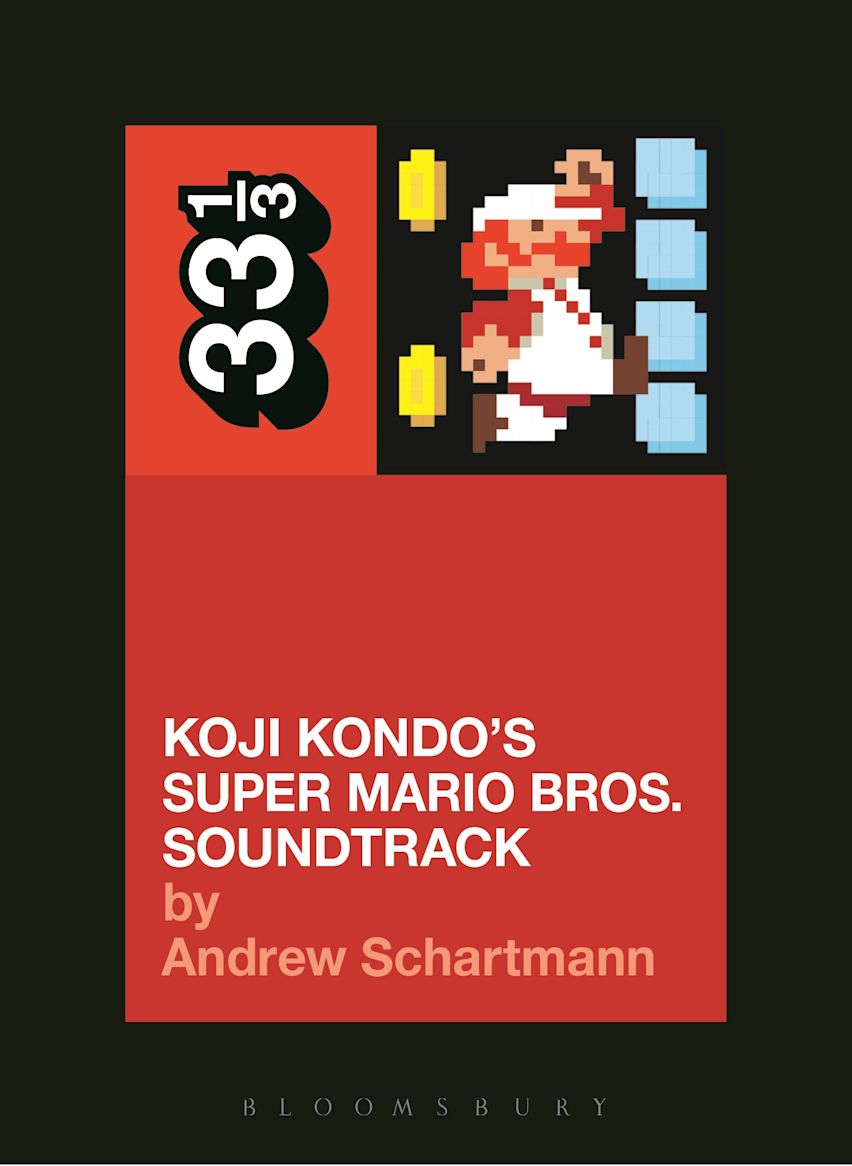
I originally wrote this review in April 2015 for my now defunct dryvetyme.tumblr.com site. Per Threads, I recently learned that Bloomsbury features a snippet of that article on its page for the book. Hence, I decided to do myself a favor and create an updated link. It’s not every day that a minor league blogger like me can appear on the same page as The Wire, The New Yorker, Pure Geekery, and others.
I have updated the review slightly for clarity.
I’m not sure which scenario felt the most dubious to me: a venerable series that critically examines seminal music choosing to review a “mere” video game soundtrack or the fact that music critics wanted to talk about video games in any fashion. Lo and behold – both perspectives came to life when the 33 1/3 folks announced in 2014 that they would publish an analysis of the original Super Mario Bros. Soundtrack. Personally, I was just excited to see this vaunted line of books stretch into new directions, but I don’t tend to spew vitriol online as a matter of course, unlike other websites trolling for clicks. Luckily for both parties, Andrew Schartmann does both the spirit of the series and video game history proud with his investigation into the iconic music of Koji Kondo.
Book #106 in the series matches a fanboy’s sensibilities with serious scholarship.
Schartmann provides the reader with an engaging discussion of Kondo’s themes and ideas, both in terms of stylistic flair and compositional acumen. He takes a fan-centered approach that’s still rooted in heady music theory, while managing to never talk down to either side of his intended audience. Of equal importance are his excellent research skills. He collects worthwhile source material and pairs them compelling quotes from Kondo and other luminaries at Nintendo to make his case for this soundtrack’s inclusion in the 33 1/3 series. The result is a superb blend of professional musicology and video game nerdery that’s reverent to our collective memories of watching Mario (never Luigi) run across screens and into our hearts since 1985.
The book is split into two sections: Contexts and Music.
The first provides a detailed history of the factors that went into making the soundtrack come to life, specifically the timelines of the video game industry, Nintendo as a company, Mario as a character, and Kondo as a composer. Schartmann also introduces the reader to the philosophy of composition that Kondo wanted to bring to bear to Super Mario Bros. as a game, especially in regard to motives, styles, feels, and textures. “… Kondo demanded that his music fulfill two principal functions: (1) to convey an unambiguous sonic image of the game world, and (2) to enhance the emotional and physical experience of the gamer.” (p.30)
Schartmann gives deserved attention to how Kondo composed his treasured soundtrack.
He explains how Kondo’s methodology was impacted by the technological limitations of the 8-bit Nintendo Entertainment System (NES). “… [A]ll NES music is part of the same sonic universe. This underlying similarity is the direct result of a common sound chip. Composers had five channels at their disposal, each of which had its own set of constraints: two pulse-wave channels, one triangle-wave channel, one noise channel, and one delta modulation channel (DMC).” (p.38) Kondo frequently flipped the script in terms of how these channels were traditionally used in order to craft his now-memorable melodies. “Mixing channels and duty cycles in different combinations could go a long way in expanding the sonic palette. With respect to Super Mario Bros., Kondo himself said, “‘… [B]y changing the way I composed the four songs, the music had a lot of variety. It was a puzzle for me, so it was a lot of fun.’” (p.41)
In the “Music” section, Schartmann delivers a comprehensive walkthrough of the four main sections of the soundtrack: Overworld, Underworld, Underwater, and Castle. He breaks down the interplay between the themes, paying special attention to how Kondo crafted memorable tunes with marked similarities that still delivered enough contrast to never bore the player. The text discusses music theory minutiae coherently and in a fan-centric way that doesn’t alienate folks who can’t read sheet music.
Schartmann’s analysis is rooted in actual game play.
It reinforces his claim that Kondo wrote these songs to enhance the experience of ushering Mario through The Mushroom Kingdom, not simply as background music. “In contrast to a rhythm that plods along with dogged metronomic consistency, Kondo’s ‘Overworld’ theme instills in us a strong desire to move. … [T]his movement is anything but stable; it’s actually quite erratic. … [T]he off-kilter rhythm keeps us on our toes, reflecting the unease we all feel when jumping from platform to platform over bottomless pits.” (pp.59, 61)
Schartmann make a sturdy case for the importance of music as intrinsic to the quality of play in a video game. “The idea that video-game music should provide more than a background distraction or atmosphere seems obvious to anyone who plays video games today. At the time, however, Kondo’s effort to bring together atmosphere, movement, and emotion was entirely new.” (p.61)
Kondo’s Super Mario Bros. Soundtrack is one of the most memorable strains of melody in the pop cultural canon, yet it’s not quite a fully realized “soundtrack” in the common parlance. By focusing on how the gamer reacts to the music and how the four main themes (and attendant variations – including “Star Man,” “Game Over,” and more) dredge up such strong emotional connections, Schartmann defeats any possible detractors and earns his book’s status as a worthy entrant in the 33-1/3 collection.
This was quite an excellent read, and I’m curious to see if additional fans of video games and music theory might want to tackle another soundtrack for this series in the future.


Leave a Reply