Admirable. Apt. Applicable.
I am not a self-help or self-improvement sort of person. Do I believe in those concepts? Absolutely. Have I benefitted from therapy over the years? Most assuredly. Do I talk to my wife, friends, and brothers about how I can become a better human? One thousand percent yes. But have I ever enjoyed reading books overflowing with feel-good tropes and fluffy platitudes that sound good in the abstract while having zero practical applications? Not at all.
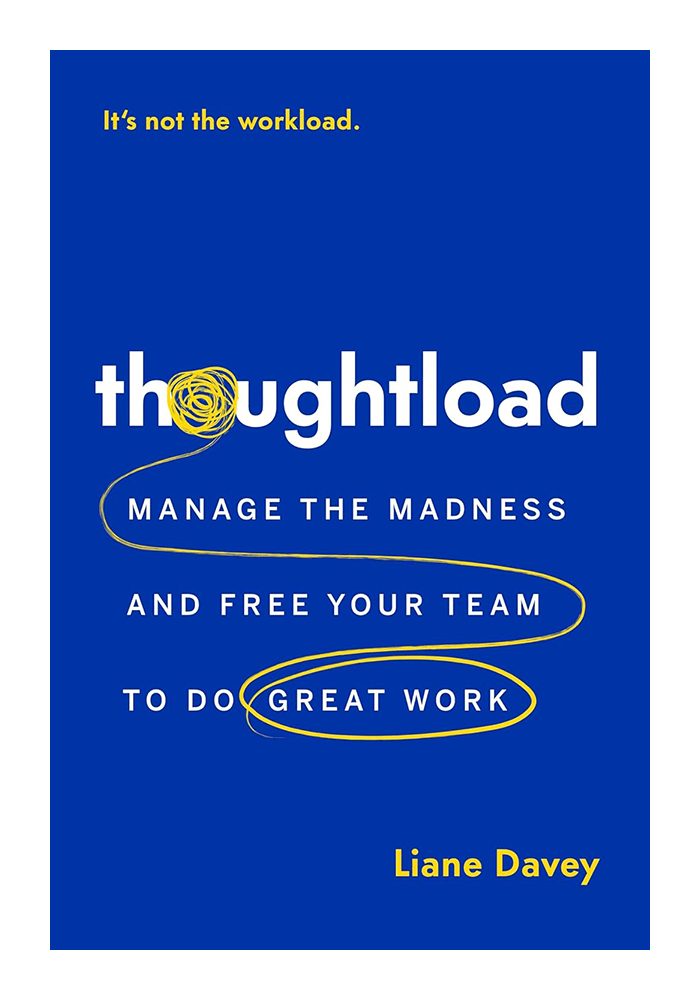
So, I was nervous when I first cracked open Thoughtload by Liane Davey. My wife picked it up for me at our local library. She read the back cover and thought it would be relevant to my recent frustrations at work. I appreciated her thoughtfulness, but I didn’t think the book would be for me. And I was so glad to be proven wrong.
Subtitled “Manage the Madness and Free Your Team to Do Great Work,” it’s a treatise on reclaiming your everyday brain space so that you can be a more productive and fulfilled leader, creator, and person. It’s one thing to say, “Stop being so distracted in the 21st century,” and another to give plainly defined tips and strategies on how to eliminate those distractions. Davey extends beyond mere advice about how to find essential focus to share helpful information about what to do at home, work, and play to clear your mind so that it can focus on what’s important.
The crucial concept is the title itself: “Thoughtload.” Her working definition looks like a math equation: (Cognitive demands + Emotional burdens) / Energy reserves. Or as I like to call it – Distractions, Drama, and Depletion. The basic pitch is that you need to decrease anything that gets in your brain and sucks the life out of you.
Sure, the answers feel obvious: Stop looking at your phone, ignore computer chats and emails as much as possible, and schedule extended time for work that requires deep thinking. Anyone living and working in 2026 understands just how difficult that can be. Davey addresses that concern by focusing on what leaders can do in the workplace to help themselves and their teams. In that sense, it’s about enforcement of boundaries, specifically, you must stand up as a leader who protects your team. It’s about defining clear processes that encourage good work and defending those processes at every available turn.
Thus, what made this book stand out for me is that she understands how people get work done. She knows that it takes room in your brain for creativity to flourish. Your psyche requires time, space, and energy, each of which gets diminished by the aforementioned “distractions, drama, and depletion.” And honestly, it would be a wonderful read for anyone who battles attention drains outside of the workplace.


Leave a comment